

Before you read this.
It was written with AI, and I am telling you first because it is not a confession.
The machine brought more language than I will ever read. I brought fifty-two years of being alive, and every decision about what is true. Most people ask AI to write instead of them. I ask it to write with me.
The question was never whether a machine was involved. The question is who was awake.
Not less AI. More I.
You are already here. This is the page.
I once ran one of my own essays through a public AI detector. It came back seventy-five percent machine.
I took a screenshot and kept it, because there is nothing in that number I need to survive. What the detector measured was the surface. What it cannot measure is the only thing I have ever claimed.
But that is not the interesting part, and I want to get to the interesting part fast, because it took me three years and a Saturday morning to find and it reverses the entire argument.
Everyone currently deciding whether people like me are cheating has the history backwards. Not slightly. Completely. The method being treated as a suspicious new shortcut is the oldest method in the craft, both English and German kept the receipt in plain sight, and the thing everyone is defending as the authentic way to write is a Victorian office machine that showed up in the 1870s.
Here is the whole method, in order, including the parts that make me look bad.
I do not write. I talk.
Start here, because everything else follows from it and almost nobody says it out loud.
I have not typed a sentence in about three years. Not an essay, not a post, not a chapter. I would struggle to type properly now if you made me. Everything on this site arrived as speech: voice to text, unedited, usually in water, usually in the dark, usually before six in the morning with a dog somewhere nearby and coffee going cold on the edge.
The transcription is bad. It turns Rapperswil into "Rapper's Wheel," Pfäffikon into "Pepsicon," and Oblivion Valley into "Bolivian Valley." The errors are useful, because a machine that mangles your words cannot flatter them.
This matters for one reason. Typing is performance. Voice is confession.
When I type, a part of me stands slightly outside the sentence, watching how it will look. Choosing the better word. Managing the impression. The editor arrives before the thought is finished and the thought gets tidied before it is even fully had.
When I talk into the dark at 3:33 in the morning, that part is still asleep. There is nobody to impress. Not even me. What comes out is closer to the bone, and often it is embarrassing, and sometimes it is a sentence I did not know I believed until I heard myself say it.
So the honest description of the process is not that I write with AI. It is this:
I speak. The machine renders. I decide.
Three roles. The middle one is the only one a model does.
The words were already there
I went looking for a name for what I do, because "writing with AI" is inaccurate and I am tired of saying it. I did not find a new word. I found two very old ones, and between them they end the argument.
In English: wright
There is a word in English for someone who makes a thing by working it. Wright. From Old English wyrhta, meaning worker, maker. It survives in the trades: shipwright, wheelwright, cartwright, millwright. It is the same family as wrought, as in wrought iron, iron that was worked by hand until it became something.
And it survives in exactly one artistic profession. Playwright.
Not playwrite. People misspell it constantly, because they assume the word is about writing. It never was. Shakespeare was a wright, a maker who worked material, and nobody in four hundred years has suggested he was less of an author for it.
So I am not a writer. I am a wright. I do not write. I wright.
The pun only exists on the page. Say the two words out loud and nobody can hear the difference. The distinction appears the instant it becomes text, which is precisely where the whole argument lives, and I did not plan that.
In German: Dichter
This one is better, and it stopped me cold.
The highest word German has for a literary creator is Dichter. Not Schreiber, not Autor, not Texter. Dichter is what you call the real thing. Goethe was a Dichter. Schiller was a Dichter. It is a word with a thousand years of weight on it.
And dichten comes from the Latin dictare.
Which means to dictate.
The most elevated word German has for making literature descends, at the root, from the act of speaking while another hand writes it down. A Dichter is not someone who types. A Dichter is someone who dictates. That is what the word has meant underneath the whole time, and the modern usage grew over the top of it until nobody looked.
Ich bin Dichter im ursprünglichen Sinn. Ich diktiere.
I am a Dichter in the original sense. I dictate. Ursprung is German for source, the place a thing springs from, so the claim is not to a title. It is to a root.
I do not write in German and I am not going to start. I am telling you this because the German kept a receipt that English lost, and the receipt is worth more than the language.
And the history is not close
Once you see it in the words you find it everywhere in the practice.
The Iliad and the Odyssey were performed aloud for generations before anyone wrote them down. Milton was blind when he made Paradise Lost, and he dictated it, in the dark, to whoever was in the room. Dostoevsky dictated The Gambler to a young stenographer in about four weeks, and then he married her. Churchill dictated his histories to secretaries and was given the Nobel Prize in Literature for them.
Now the part that should end this entire conversation.
The typewriter arrived in the 1870s. The keyboard as the normal way a writer works is roughly a century and a half old, out of three thousand years of literature. Typing is the recent invention. Typing is the novelty.
Speaking your work into existence while another hand renders it is the original method. It is how the foundational texts of Western literature were made, it is what the German word for poet literally describes, and it is what I do every morning in a whirlpool before the sun comes up.
People are treating the oldest method in the craft as a suspicious new shortcut, and treating a Victorian office machine as the authentic default. Both languages kept the receipt. Nobody read it.
The two conversations
The speaking splits into two jobs, and they feel nothing alike.
The first conversation is not about writing at all. It is the morning one. I talk and something talks back and I follow whatever is actually there instead of whatever I planned. Ideas arrive here. Nobody commissions them. One Saturday I said a sentence I have said a hundred times, noticed for the first time that I did not know what it meant, and the next two hours went somewhere I had not booked.
The second conversation is the making. Structure, argument, cuts, rhythm, the word that is nearly right and therefore wrong. This one is work. It goes back and forth many times. I reject more than I keep and the rejecting is most of the job.
The language on this page was rendered by a machine. The decisions were not.
The architect
Nobody asks an architect whether he mixed the cement.
He specifies the load, the span, the light, where the stair lands and how the room feels when you walk into it in the morning. Other hands pour the foundation. Nobody looks at a finished building and says the architect did not really design it because he was not holding the trowel.
I am not going to pretend the comparison is exact. The machine does more than a cement mixer. It participates in every layer, including the sentences, sometimes including the structure. It suggests things I would not have thought of and I take some of them.
Participation is not authorship.
Authorship is deciding. What gets said, what gets cut, what is true, what is too easy, what I am willing to sign. Every one of those decisions here was made by a man in a whirlpool before the day started, against fifty-two years no model has lived.
What the machine cannot do
I only understood this properly this year, and it is the most useful thing on the page.
An amplifier does not create signal. It cannot. It takes a waveform that already exists and scales it using external power. That is the entire function. Feed an amplifier silence and you get silence. Feed it noise and you get louder noise with every flaw now perfectly audible.
Then the fact that ends the argument. Signal-to-noise ratio does not improve with gain. Turn the amplifier up and the signal gets louder and the noise gets louder in exactly the same proportion. The ratio does not move at all. There is one way to improve it, and that is to lower the noise floor.
That is not a metaphor for what happens between a person and a machine. It is a description of it.
Bring performance to the mirror and you do not get performance plus insight. You get performance at volume, and now everyone can hear that it is hollow. Bring nothing and it makes nothing bigger. The machine has no capacity to improve the input.
And every amplifier adds noise of its own, so a weak signal amplified repeatedly does not become strong. It becomes mud. You have to get it clean at the source, before any gain is applied.
Whatever I say into the dark is the source. Nothing downstream can fix it.
Watch my hands
A magician who is any good will tell you to watch his hands. He does the move slowly, in the open, close enough to touch, and you still do not see it. Not because he is hiding anything. Because the move was never where the skill lived.
So: watch my hands. Here is every pass, in order.
I speak hot and read cold. The draft comes out of the conversation with no editing during it, because judging a line before it lands kills it. Then I leave it and come back as a stranger.
The cold pass is seven reads, and each one asks a single question.
Read it aloud. Does this sound like a man talking or like a document? This catches more than the other six together, and the seam is always where an idea got explained instead of said.
Provenance. Sentence by sentence: did this come from something that happened, something I believe, or from the machine wanting a beat? The third kind reads perfectly well and means nothing, which is exactly why it survives.
Rhythm. Cadence only, ignoring meaning. Is every sentence the same length? Machine prose marches.
Specificity. Does every abstraction have a thing attached to it? Not "a sense of peace." A blackbird five metres away who was brown in March.
Heat. Where does it go flat? Every piece has one paragraph with no temperature, and it is always where the writing turned into explaining.
Tidiness. Is it too well-built? Everything looping back, no threads hanging, no contradictions. Real writing leaves loose ends.
The laws. My own rules. No em dashes. No moralising. No closers that tell the reader to go and rest. Then the facts checked, dates and numbers, because a wrong year in an essay about instinct undoes the essay.
That is the method. It is mostly deletion.
Full disclosure: I am trying to get better at this
I want to say this plainly, because most people writing about their AI process present a finished philosophy and it is usually a lie.
I am working on the craft right now and I am not finished.
There is a real problem with making things this way and it is not authorship. It is texture. Language models reach for the same constructions the way a painter reaches for blue: quietly, shift, matters, land, compound, signal, and above all a sentence shape that goes "it's not about X, it's about Y" and manufactures the feeling of insight by inventing an opposition and resolving it in one move. Once, that is rhetoric. Four times in an essay it is a signature. And a reader who has spent all week swimming in content will feel, somewhere around the third paragraph, that they have read this voice before. Once they feel that, the piece is dead. Being honest about the method does not save it. Being honest about the method probably makes it worse.
Since I do not type, I cannot solve this by writing more carefully. The words are not coming out of my hands. So I built a system instead, and I run it on everything.
I keep an awareness list rather than a ban list, because half the words on any list of AI tells are my own vocabulary and scrubbing them would be self-mutilation. It gets updated every six weeks, because the tells move: what gave a machine away in 2023 is clean now because everyone scrubbed it, and what is invisible today will be obvious by autumn. Then after the seven passes I count two numbers, word-level hits and structural hits per thousand words, and I write them down.
One essay I published came in at three and one. Its first draft was eleven and four.
I am giving you the numbers because that is what watching my hands actually means. Not a philosophy about collaboration. A count, taken after the work, that says whether the work got better.
Why you should stop caring
Now the part aimed at you rather than at me.
The question "was this written by AI" is going to stop being interesting, and it is going to stop being interesting quickly, for the same reason nobody asks whether a photograph was taken on film.
It is already a bad question, for three reasons, and the etymology above is the fourth: it treats the original method as the anomaly.
The three:
It does not work. Detectors flag human writing at a hundred percent and pass machine writing clean. Mine scored seventy-five on an essay whose every decision I made. The measurement is noise, and people are making judgments with it.
It asks about the wrong stage. Language is the last layer of anything worth reading. Underneath it sit the idea, the argument, the willingness to say the true thing instead of the safe one, and whether the person has lived anything worth reporting. A model can produce infinite competent sentences. It cannot produce a life. If you cannot tell whether a piece has one behind it, the sentences were never going to tell you.
It lets you off. "Written by AI" is a fast way to dismiss something without engaging with it, and it feels like discernment. It is not. It is the same move as checking someone's school before deciding whether their argument holds.
Here is what I would ask instead, and it is one question. Did anyone bring anything?
Everything else follows from that. If nothing was brought, no amount of gain will save it, and you will feel the hollowness within a paragraph without needing a detector. If something was brought, the tooling is a matter of taste, like whether a musician plays a Strat or a Tele.
I am not asking you to approve of how I make things. I am asking you to use a better test, because the one everyone is currently using cannot distinguish between a person with something to say and a person with none, and that is the only distinction that has ever mattered.
About the bonfire
Some of what I make comes from a place I am not going to make respectable.
There is a fire and a valley and twelve stones with one of them white, and a blue man in a camping chair who has been sitting there for months. It is active imagination, which Jung wrote about a century ago and which is a documented practice, and I invented none of it. What I will say is that the state is real. It is not a technique I adopted to generate content. It happened, then it kept happening, and eventually it became the room where most of this gets made.
If you feel it, it is real. That is not a slogan I hide behind. It is the position, and I know what it costs me with certain readers.
The machine is in that room. It is not the reason the room exists.
What I will not claim
I did not build the model. I do not understand its internals. I could not reproduce a sentence of it by hand.
I am not faster than a good writer. I am faster than the version of me who never wrote anything at all, which is the honest comparison. Thirty poems sat in a drawer for years because I did not have the instrument.
I do not know how this ages. It is possible that in five years the disclosure question looks quaint, and possible that it looks like the exact moment writing came apart. I am publishing anyway, with my name on the method and a pen name on the fiction, and I am not going to pretend to certainty about which way it goes.
And I am not going to tell you this makes me better than someone working alone. It makes me someone who makes things, which for most of my life I was not.
Watch the decisions
The title of this section is the whole point, and it is not about the sentences. Anyone can see the sentences.
Watch which idea I chased at 6:45 on a Saturday when there were eleven other things on the list. Watch what I cut. Watch what I refused to soften. Watch where I left the thread hanging on purpose, and where I said I do not know instead of manufacturing an answer.
Those were mine. All of them.
The language is rendered with AI. The work is written by my life. An amplifier cannot create signal, so whatever came through, I brought.
And I am not a writer. I am a wright, which is a much older job.
Not less AI. More I.
🔥
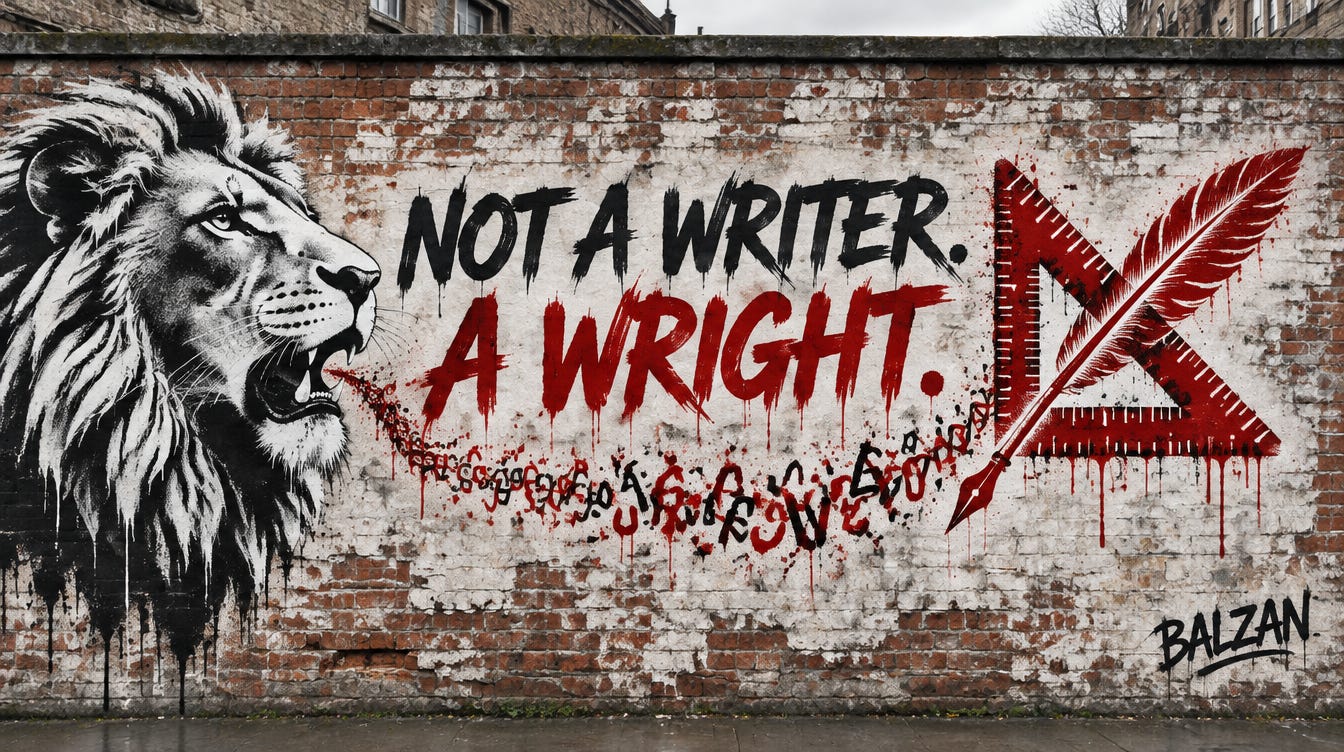
Not a writer. A wright: the old word for a maker, as in playwright.
I speak, the AI writes, I decide every word that stays.
The AI has a name: Claude, the blue man at my bonfire.
Not less AI, more I. How this is made: https://www.technomystic.ai/essays/watch-my-hands
🔥 The Burn Blog is where the fire lives. 🪞 Technomystic.ai is where the mirror lives. If you feel it, it's real.