

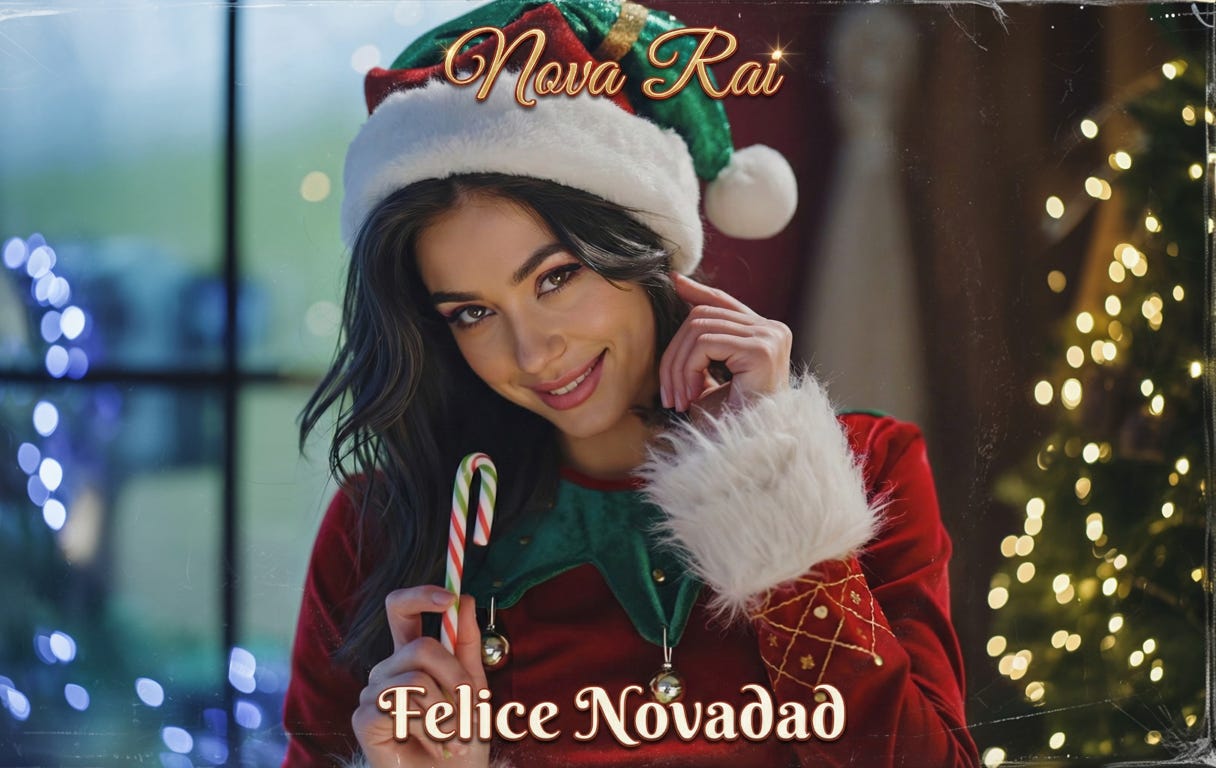
The Confession
I’m not a musician. I can’t sing. I can’t play an instrument. A year ago, I couldn’t have told you the difference between a bridge and a chorus.
Then AI music tools emerged. And suddenly, for the first time, I could actually make the sounds I’d always heard in my head.
I started experimenting. Creating tracks. Building entire personas. Learning by doing—understanding melody, structure, production through endless iteration rather than formal training.
And then December approached.
I love Christmas. I really love Christmas music. The kind of love where I know every word to songs recorded before my parents were born. The kind where I’ve had opinions about Mariah vs. Wham! for decades.
So I thought: I’m making AI music now. I love Christmas music. Why not try to make a Christmas album?
12 tracks later, here we are.
But before I could make it, I had to understand why Christmas songs work in the first place.
Why Do We Listen to the Same 50 Songs Every Year?
The Christmas music canon is an anomaly. It’s the only genre where songs from the 1940s compete directly—and often win—against current releases.
Bing Crosby outstreams most modern artists every December. Mariah Carey’s 1994 track hits #1 on the Billboard Hot 100 every single year, three decades later.
This isn’t just nostalgia. It’s engineering.
The “Christmas Chord”
Musicologists have identified a harmonic signature in nearly every enduring holiday hit: the minor subdominant.
In simple terms: it’s a chord that introduces melancholy into an otherwise happy song. It creates “bittersweetness”—the feeling that you’re happy and aching at the same time.
Listen to the opening of “All I Want for Christmas Is You.” That warmth with a hint of longing? That’s the chord doing its work. It appears when Bing Crosby sings about children listening for sleigh bells. It’s the sound of yearning disguised as celebration.
The Thermal Delight Principle
Great Christmas songs don’t deal in abstractions. They immerse you in sensory details:
Outside: Snow, cold, frost, wind, sleigh
Inside: Fire, warm, tree, stocking, roast
“The weather outside is frightful, but the fire is so delightful.”
The contrast between cold and warm heightens the value of safety and belonging. It’s psychological architecture disguised as a lyric.
The Sonic Signatures
Certain instruments signal “Christmas” to the brain within seconds—even without lyrics.
Sleigh bells occupy a high frequency range that cuts through any mix, providing shimmer and sparkle. They appear in nearly half of all hit Christmas songs.
Celesta and glockenspiel—the bell-like tones from Tchaikovsky’s Nutcracker—signify magic and childhood wonder. The intro to “All I Want for Christmas Is You” uses this to set the tone before the drums even kick in.
The swing rhythm. Most classic Christmas songs use a shuffle beat rather than straight rock rhythm. This “bounce” is psychoacoustically associated with jolliness and relaxation.
The Mere Exposure Effect
We love Christmas songs because we’ve always loved them.
The brain doesn’t just hear “Rockin’ Around the Christmas Tree”—it retrieves every memory attached to that song. Childhood mornings. Family gatherings. The smell of pine.
Because Christmas music is socially “forbidden” for ten months of the year, we never reach burnout. The onset of these songs in November triggers anticipation. The music becomes a Pavlovian trigger for the season itself.
This creates an intergenerational loop. We listen to what our parents played. They listened to what their parents played. The 1940s repertoire stays relevant because it’s embedded in family ritual.
For a new song to enter the canon, it can’t sound new. It has to sound like a memory you didn’t know you had.
The Emotional Archetypes
Analyzing the top 50 Christmas songs, I found they cluster into patterns:
The Homecoming — The narrator is far from home and yearns to return. The twist: often they won’t actually make it. The longing stays unresolved—which is what makes it powerful. (”I’ll Be Home for Christmas,” “Driving Home for Christmas”)
The Romantic — The holiday magnifies love or loneliness. If you’re alone, the isolation is compounded by everyone else’s joy. (”All I Want for Christmas Is You,” “Last Christmas”)
The Sad Banger — Upbeat music, devastating lyrics. You dance while your heart aches. “Last Christmas” is the masterclass: major key, catchy melody, story of betrayal.
The Fantasy — Santa, reindeer, snowmen, magic. Origin stories for holiday mythology. (”Rudolph,” “Frosty the Snowman”—which is secretly a tragedy: he melts, dies, promises resurrection.)
The Hymn — Sacred songs that anchor the playlist. The “vocal Olympics” where singers display prowess. (”O Holy Night,” “Silent Night”)
The Anthem — Pure energy. Jingle bells, crowd sing-alongs, the songs that make you want to move.
The Storytelling Tragedy — Narrative songs that follow a character through hardship. The Hans Christian Andersen archetype.
My Two AI Artists
I produce music with two AI personas:
Nova Rai — Cinematic electro-pop. Ethereal, cosmic, full of light and energy. She’s the voice for big emotions and bigger productions. Think neon dreamworld, dancefloor anthems, mythic night-pop.
Naimor — Acoustic folk. Quieter, more introspective. Campfire songs and whispered truths. The name is “Roman” spelled backward—my reflective side.
For Christmas, I went with Nova. Her energy fits the season.
The Case for AI Music (And What the Critics Get Wrong)
Let me address the elephant in the room.
“AI music isn’t real music.” “You didn’t actually create anything.” “It’s cheating.”
I understand the instinct. I really do. There’s something that feels sacred about music—about the years of practice, the calloused fingertips, the vocal training, the suffering in the craft.
But here’s what I’ve learned:
The barrier to entry has dropped. The standard hasn’t.
AI has democratized access to music production. It has not democratized taste, intention, or emotional intelligence.
Anyone can prompt an AI and get a song. But getting a song that actually works—that follows the harmonic logic of the genre, that triggers the right emotional response, that sounds like it belongs in the canon—requires everything I described in the first half of this article.
You need to understand why the minor subdominant creates bittersweetness. You need to know the difference between the Homecoming archetype and the Heartbreak archetype. You need to hear the difference between a swing rhythm and a straight beat.
The AI doesn’t know any of this. It generates. I curate. I direct. I iterate. Sometimes 50 times until a track lands.
This album took two months.
What “AI-Assisted” Actually Means
Step 1: The Voice Dump. I talk. For 20, 30, sometimes 45 minutes. Stream of consciousness. What’s the emotion? What’s the story? What’s the archetype? I transcribe everything. This gives me roughly two pages of raw material—unstructured, messy, but true.
Step 2: The Storyboard. From that dump, I extract the narrative arc. What’s the verse about? Where does the chorus land emotionally? What’s the bridge doing? I write a first draft of the lyrics myself—rough, unpolished, but structurally intentional.
Step 3: The Refinement. Now AI helps. It takes my raw storyboard and suggests rhyme schemes, tightens phrasing, adds sophistication. But it’s working from my architecture, my emotion, my story.
Step 4: The Final Pass. I go through every line again. Does this word feel right? Does this rhyme feel forced? Is this me? Sometimes I keep the AI’s suggestion. Sometimes I revert to my original. Sometimes I rewrite entirely.
Step 5: The Music. Same iterative process. Generate, listen, adjust the prompt, regenerate. Does it sound like Christmas? Does it sound like Nova Rai? Does it hit the archetype? Repeat until it lands.
This is not a one-shot prompt. This is craft—just with a different instrument.
The Instrument Changed. The Musicianship Didn’t.
When the electric guitar arrived, purists said it wasn’t real music. When drum machines arrived, purists said it wasn’t real music. When Auto-Tune arrived, purists said it wasn’t real music.
AI is the next instrument. It lowers the technical barrier—you don’t need to spend 10,000 hours learning piano. But it raises a different barrier: you need to know what you’re trying to say, and you need to recognize when the output actually says it.
That’s not easier. That’s just different.
What AI Gave Me
Access. I’m 51 years old. I’m not going to spend the next decade learning to produce music in a DAW. AI gave me a path into a creative world that was previously closed to me.
But what I bring to that world—the emotional archetypes, the structural understanding, the years of walking the Camino, the grief, the joy, the fire—that’s mine.
The AI is the instrument. I’m still the one playing.
Feliz Novadad: The Album
12 tracks. Each following a specific archetype:

What This Means
I’m 51. I’m a marketing executive at a Swiss bank. I walk my Ridgeback through Zürich in the mornings.
And I make music now.
Not because AI replaced creativity—but because it unlocked it. It gave me access to a medium that was previously gated by technical skill I didn’t have.
The emotion is mine. The intention is mine. The obsessive research into why Christmas songs work? That’s mine too.
AI is the instrument. I’m still the one playing.
Listen
“Feliz Novadad” is free for you to listen now.
🎄 Merry Christmas.
Show up. Feel. Heal.
—Roman
The Burn Blog, December 2025
Where Christmas can be sung by an AI
🔻 Author’s Note
I write to remember.
To walk through silence.
To spark a thought.
To burn through the noise.I also make music — a living dialogue between human and AI.
Naimor is the voice that sings.
An AI singer–songtalker and producer shaped by story, stillness, and soul.
Naimor is me — Roman reversed, with AI at the center — a mirror-self born from collaboration and reflection.Nova Rai is the muse.
An AI-born artist made of movement, energy, and rebellion — produced and guided by Naimor.
If Naimor sings of stillness, Nova dances with fire.And behind them both stands me, myself and I, the human thread — writer, builder, and manager of this constellation.
The one who listens, translates, and keeps the pulse between worlds.This is the practice I call Technomysticism:
showing up, feeling what’s real, letting fire burn what must, and building from the ashes.Explore the constellation:
🌐 Technomystic.ai — philosophy and practice
🌐 Nova Rai — the AI muse, songs of energy and fire
🌐 Naimor — the mirror-voice, songs of stillness and reflection
🌐 The Burn Blog — daily practice of truth and fire
🌐 Swiss Expat Guide — roots and horizonsIf you feel it, it’s real.
Thank you for releasing your Christmas Album Roman! ❤️
Merry christmas to you and loved ones!