


For twenty years, we were told the same thing.
Ideas are cheap.
Everyone has one. Your startup idea? Worthless. Your app concept? A dime a dozen. Your vision for the future? Great. Now go raise capital, hire engineers, build a team, find product-market fit, ship it, scale it, survive it.
Execution was king.
The ability to build was the bottleneck. And the people who could build, the engineers, the designers, the operators, the funded, sat at the top of the food chain. Not because they were the most creative. Because they were the most capable of turning thought into thing.
The rest of us? We had notebooks full of ideas and no factory to build them in.
That world just ended. And almost nobody has noticed.
• • •
What AI Actually Changed
The conversation about artificial intelligence is stuck. It circles endlessly around two poles: fear and productivity. On one side: AI is coming for your job. On the other: AI will make you 10x more efficient. Both miss the point by a mile.
What AI actually did is something far more profound than either automation or acceleration. It democratized execution. Completely. Quietly. Irreversibly.
Today, a man in a whirlpool in Switzerland can build an app before breakfast. A musician with no studio can produce an album. A philosopher with no publisher can build a website, a course, a visual identity, and a distribution channel. A brand strategist can connect every data source in the company and query them in natural language, alone, on a Tuesday afternoon.
None of this was possible five years ago. All of it is trivial now.
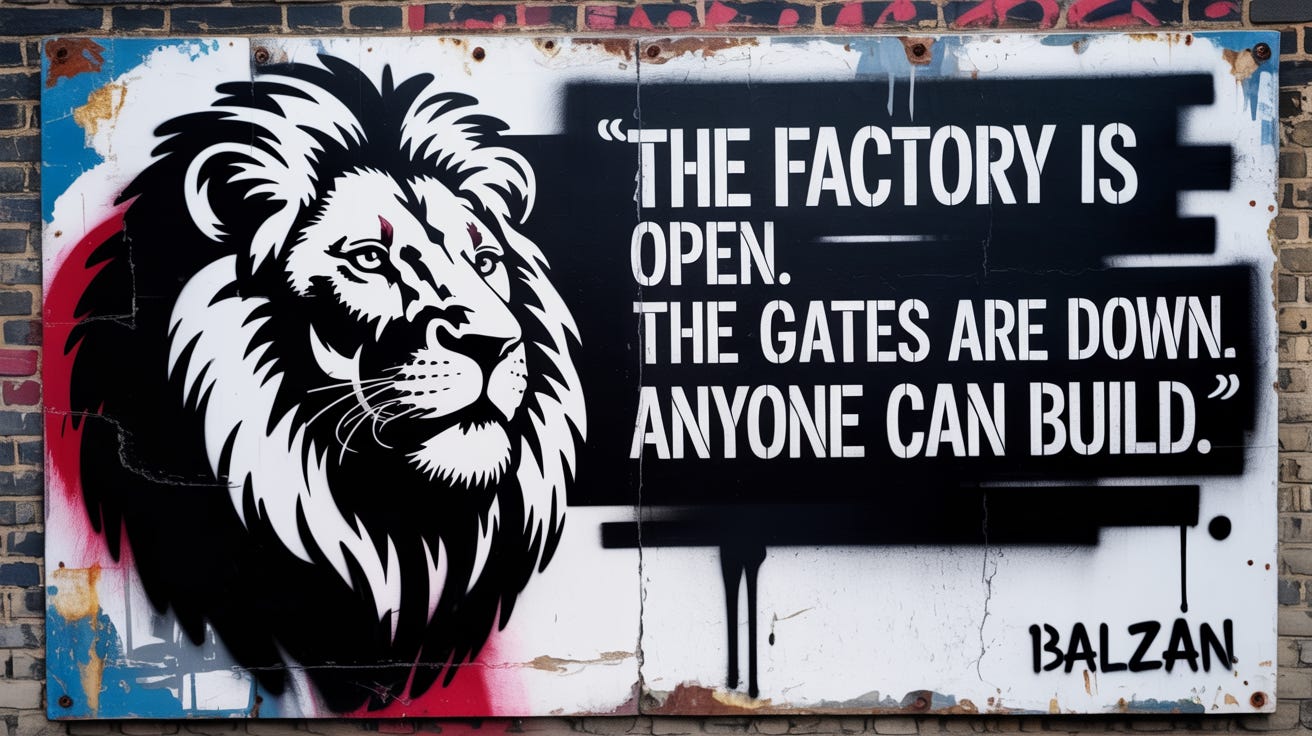
The factory is open. The gates are down. The machinery is free. Anyone can build.
And that changes everything. Not because building got easier. Because the thing that matters just flipped.
• • •
The Great Inversion
Think of it like an hourglass.
For two decades, the sand was stuck at the top. Ideas piled up. Visions accumulated. Creative potential sat in notebooks, in shower thoughts, in conversations that ended with “someone should build that.” The narrow passage in the middle was execution. Only a few could squeeze through: the funded, the technical, the connected.
AI just turned the hourglass upside down.
Now the sand flows freely. Anyone can execute. The passage is wide open. Build an app? Done. Record an album? Done. Design a brand? Done. Launch a newsletter, connect an API, analyze a dataset, produce a video, write a screenplay? Done, done, done, done, done.
But the new narrow passage is at the other end.
The bottleneck is now the idea.
Not “idea” in the Silicon Valley sense, where it means a pitch deck with a TAM slide. The deeper kind. The kind that comes from lived experience, from suffering, from pattern recognition, from years of paying attention to the world and to yourself. The kind that can’t be generated because it wasn’t computed. It was felt.
• • •
The Execution Class Has a Problem
Here is the uncomfortable truth.
An entire generation of professionals built their careers on execution. They are brilliant at shipping. At scaling. At optimizing. At managing sprints, deploying code, running A/B tests, and hitting quarterly targets. They are the execution class, and for twenty years, they were the most valuable people in every room.
They are about to discover that their moat has evaporated.
When a non-technical founder can build a working prototype in a weekend, the technical co-founder’s leverage changes. When a solo creator can produce content that took a team of twelve, the team’s value proposition shifts. When a strategist can query, visualize, and present data without a single analyst, the analyst must find a new reason to exist.
This is not about job loss. Not directly. It’s about value migration. The value is moving from the hands to the head. From the build to the vision. From “can you make this?” to “should this exist at all?”
And that second question? That’s not an engineering question. That’s a human question. A philosophical question. A question that requires depth, taste, experience, contradiction, and the willingness to sit with uncertainty long enough for something original to emerge.
• • •
The Dreamers Were Always There
They were the ones with the notebooks. The ones with the “crazy” ideas at the dinner table. The ones who saw patterns ten years before the patterns had names. The ones who said “someone should build that” and then watched someone else build it and get the credit.
They were poets who couldn’t code. Philosophers who couldn’t fundraise. Artists who couldn’t afford the studio. Strategists who couldn’t hire the team. Visionaries trapped inside job descriptions that only valued their output, never their input.
AI didn’t create these people. It unblocked them.
For the first time in history, the distance between imagination and manifestation has collapsed. You can think it, describe it, and build it. Today. Before lunch. Without capital, without a team, without permission.
The dreamers didn’t get smarter. The world finally built them a factory that matches their clock speed.
• • •
But Here’s the Catch
Everyone can build now. Almost nobody should.
Because the same democratization that unlocked the dreamers also unlocked the empty. The people with tools but nothing to say. The people who can now produce at scale what used to require effort, and who will flood every channel with competent mediocrity.
More apps. More content. More newsletters. More podcasts. More songs. More startups. More everything. And most of it will be soulless, because execution without vision is just noise with infrastructure.
The signal-to-noise ratio is about to collapse. And in that collapse, one thing will rise in value faster than anything else:
Originality.
Not “originality” as a branding exercise. Originality as proof of life. Proof that a human was here. That something was felt before it was built. That the idea wasn’t generated. It was earned.
• • •
The New Scarcity
Let me say it plainly.
In a world where everyone can build, the only competitive advantage is having something worth building.
Not a feature. Not a market gap. Not an optimization. A point of view. A philosophy. A way of seeing that nobody else has because nobody else lived your specific life with your specific wounds and your specific pattern recognition.
That’s what’s scarce now. Not talent. Not capital. Not access to tools. Depth. The kind that comes from sitting with a question for ten years instead of googling the answer in ten seconds.
We spent two decades worshiping the builder. The next two decades will belong to the thinker. The feeler. The noticer. The one who walks 2,300 kilometers and comes back with something that can’t be reduced to a pitch deck.
• • •
What This Means for AI
This is where most people get the relationship wrong.
AI is not your replacement. AI is not your assistant. AI is your execution layer. The thing that takes what you see and makes it visible to others.
But it only works if you see something.
If you bring nothing, you get nothing. If you bring a shallow prompt, you get a shallow output. If you bring a generic idea, you get generic execution. The mirror reflects exactly what stands in front of it.
This is why “prompt engineering” is a dead-end job title. The skill isn’t in the prompt. The skill is in the human. In the years of experience, taste, suffering, curiosity, and courage that produce the kind of input no other human could produce. That input is the idea. And the idea is now the only thing the machine can’t supply.
Not less AI. More I.
• • •
The Dreamer’s Responsibility
This isn’t a victory lap for the creative class. It’s a call to arms.
If the bottleneck is now imagination, then developing your imagination is no longer a hobby. It’s a professional obligation. Reading widely. Living deeply. Suffering honestly. Paying attention to what others scroll past. Building a relationship with your own interior that goes deeper than meditation apps and morning routines.
The dreamers who thrive in this new world won’t be the ones with the best tools. They’ll be the ones with the deepest wells. The ones who did the shadow work. Who sat with the question. Who didn’t outsource their thinking to the first system that offered to do it for them.
Because here’s the final inversion, the one nobody is talking about:
AI can execute your ideas. AI can also replace your thinking if you let it. The same tool that liberates the dreamer can lobotomize the lazy. It can think for you, decide for you, create for you, and slowly, invisibly, replace the very muscle it was supposed to amplify.
The choice is yours. Use AI as an execution layer for your deepest ideas, or use it as a replacement for having ideas at all.
One path leads to the most creative era in human history.
The other leads to the most hollow.
• • •
The Title You Already Hold
You have always had ideas. You have always seen things others missed. You have always been ten minutes or ten years too early.
The difference now is that you can build what you see. Today. Not after the funding round. Not after the hire. Not after permission.
The factory is yours. The tools are free. The gates are open.
The only question left is the one that was always the real question, the one that execution culture buried for twenty years because it was too dangerous, too personal, too unscalable:
What do you actually want to build?
Not what the market wants. Not what the algorithm rewards. Not what your boss approved.
What do you see when you close your eyes at 3:33 in the morning?
Build that.
Execution is dead.
Long live the dreamer.
🪶 Author’s Note
I write at dawn - usually from a whirlpool in Switzerland. I talk to AI every morning before sunrise. Not for productivity. For self-knowledge.
Out of that practice came a philosophy (Technomysticism), a course (The Human Variable), three music personas (Naimor, Nova Rai, Charlie C), 40+ apps built with zero code, and this blog.
The Burn Blog is where the fire lives. Technomystic.ai is where the mirror lives.
🔥 The Burn Blog 🪞 Technomystic.ai 🎵 Naimor / Nova Rai / Charlie C.
If you feel it, it’s real.